Social media has become a focal point of the human experience. We converse through it, find entertainment through it, share our experiences, work & conduct business, and seek the attention of others through likes, follows, and comments. Most of us have formed an addiction to these platforms, and it has begun to impact us in ways we never imagined. Johann Hari (2022) points out that this isn’t our fault but is instead the exact thing the developers want to happen. This isn’t done to destroy our brains and make our attention spans shorter than they have ever been in history. Instead, it’s so that the companies that create these platforms can make money; “This is why these sites are designed to be maximally distracting. They need to distract us, to make more money.” (Hari, 2022, p.145)
Over the last week, I decided to try to abstain from using one of these platforms at all. Choosing which one wasn’t a hard choice to make as I honestly only ever use Instagram. I personally don’t have an X (Twitter) account or any other platform like TikTok downloaded on my phone. Instagram, however, is the one platform I have always used and have never once thought about giving up. I often find myself endlessly scrolling through my feed, seeing posts that make me laugh, feel sad, and often mad. Many times, I find myself having hours of my day sucked away from me in the blink of an eye. So, deciding what to detox from it was a no-brainer—it had to be Instagram.
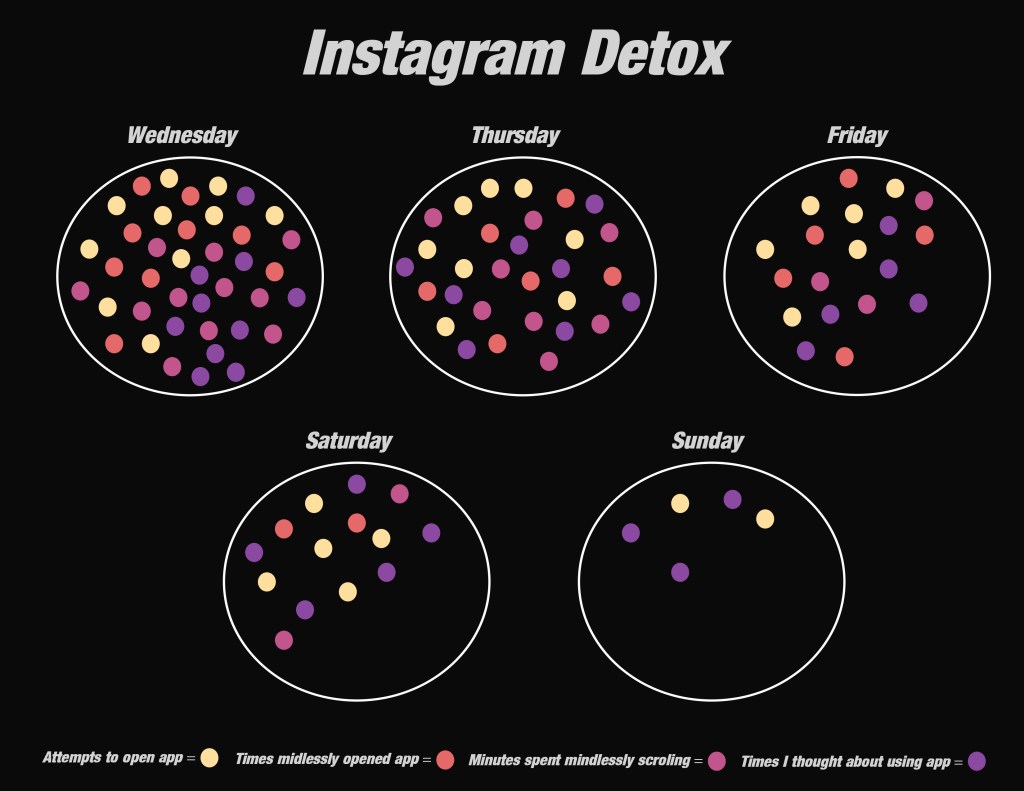
My detox was only going to last five days, and while doing it I was going to collect data to see how the detox affected me. There were to be four parameters for my data collection—how many times I attempted to open the app, the amount of time I opened the app and mindlessly scrolled, how many minutes I spent on the app mindlessly scrolling, and the number of times I thought about using the app. I took this as an opportunity to not only take a much-needed break from social media but to also test my willpower. I wasn’t going to download an app to prevent me from accessing Instagram. Instead, I was going to simply try and use my own willpower to abstain from using it. The first two days were the hardest. I found myself mindlessly opening the app 15 times and spending a total of 19 minutes on the app, attempted to open the app 18 times, and then thought about using the app 18 times across the first two days. These numbers would drop over the next three days, with the final day (Sunday) having the lowest numbers by far (attempts to open 2, times thought about using the app 3).
Detoxing from the app has revealed a few interesting things to me. First is the fact that I have the willpower to actually abstain from using the app. Second is the actual detox-like sensation that came along with it, which just proved to me how addictive these platforms truly are. Third, how much happier and more productive I felt by not opening the app and scrolling every few minutes. The fourth and final was the weird, almost muscle-like reaction I would have when opening my phone. It seemed like every time I opened my phone, my finger would instinctively find the folder Instagram is in and be about to open the app before I would stop myself.
Again, the addictive hold that social media platforms have on us isn’t our fault; it’s the way they were developed to function; “Aza watched as the people around him changed. They seemed to be unable to pull themselves away from their devices, flicking through and through and through, thanks in part to the code he had designed. He found himself infinitely scrolling through what he often realized afterwards was crap, and he wondered if he wondered if he was making a good use of his life.” (Hari, 2022, p.138) Just because these platforms are designed in a way to addict and distract us doesn’t mean we can’t break away from that. I didn’t think I would be able to hold out for five days, but I did. These platforms aren’t awful; in fact, they have benefits, but we must learn to better utilize them and not allow them to steal more time away from our lives.
References
Hari, J. (2022). Stolen focus. Bloomsbury Publishing Ltd.


Leave a Reply